Extracting rule sets from an explainable LEMOO method
This notebooks showcases how the learned rules in an XLEMOO method can be extracted and explored.
Imports
We start with the imports needed to run the example.
[1]:
import sys
sys.path.append("../../../XLEMOO")

from XLEMOO.LEMOO import EAParams, MLParams, LEMParams, LEMOO, PastGeneration
from XLEMOO.fitness_indicators import asf_wrapper
from XLEMOO.selection import SelectNBest
from XLEMOO.plotting import show_rules
from XLEMOO.ruleset_interpreter import extract_skoped_rules
from desdeo_emo.recombination import SBX_xover, BP_mutation
from desdeo_tools.scalarization.ASF import PointMethodASF
from desdeo_problem.testproblems import vehicle_crashworthiness

import matplotlib.pyplot as plt
import numpy as np
from imodels import SkopeRulesClassifier
Initialize the problem
We next initialize the vehicle crash worthiness problem.
[2]:
n_objectives = 3
n_variables = 5

problem = vehicle_crashworthiness()
Initialize an XLEMOO method
Next, the parameters needed to initialize the XLEMOO method are defined. As the interpretable machine learning model, Skope rules are utilized.
[3]:
ideal = np.array([1600.0, 6.0, 0.038])
nadir = np.array([1700.0, 12.0, 0.2])
ref_point = np.array([1650.0, 7.0, 0.05])  # the reference point

# define the achievement scalarizing function as the fitness function
ref_asf = asf_wrapper(PointMethodASF(ideal=ideal, nadir=nadir), {"reference_point": ref_point})
fitness_fun = ref_asf

lem_params = LEMParams(
    use_darwin=True,
    use_ml=True,
    fitness_indicator=fitness_fun,
    ml_probe = 1,
    ml_threshold = None,
    darwin_probe = None,
    darwin_threshold = None,
    total_iterations=10,
)

ea_params = EAParams(
    population_size=50,
    cross_over_op=SBX_xover(),
    mutation_op=BP_mutation(problem.get_variable_lower_bounds(), problem.get_variable_upper_bounds()),
    selection_op=SelectNBest(None, 50),  # keep population size constant
    population_init_design="LHSDesign",
    iterations_per_cycle=19,
)

ml = SkopeRulesClassifier(precision_min=0.1, n_estimators=30, max_features=None, max_depth=None, bootstrap=True, bootstrap_features=True, random_state=1)
ml_params = MLParams(
    H_split=0.20,
    L_split=0.20,
    ml_model=ml,
    instantiation_factor=10,
    generation_lookback=0,
    ancestral_recall=0,
    unique_only=True,
    iterations_per_cycle=1,
)

lemoo = LEMOO(problem, lem_params, ea_params, ml_params)
Run the XLEMOO method
The XLEMOO method is then run for a set number of iterations in both its Darwinian and learning modes. The output shows how many iterations were spent in each mode.
[4]:
lemoo.run_iterations()
[4]:
{'darwin_mode': 190, 'learning_mode': 10, 'total_iterations': 10}
Extract most accurate rules
Then, the most accurate rules are extracted.
[5]:
rules, accuracies = extract_skoped_rules(lemoo.current_ml_model)
problem_lower_bounds = problem.get_variable_lower_bounds()
problem_upper_bounds = problem.get_variable_upper_bounds()

rules_for_vars = {f"X_{i}": {">": [problem_lower_bounds[i], -1], "<=": [problem_upper_bounds[i], -1]} for i in range(n_variables)}

for accuracy, rule in zip(accuracies, rules):
    for key in rule:
        var_name = key[0]
        op = key[1]

        # check accuracy
        if rules_for_vars[var_name][op][1] < accuracy:
            # update accuracy
            rules_for_vars[var_name][op][1] = accuracy
            if op == "<=":
                # tighten rule, if necessary
                if float(rule[(var_name, op)]) <= rules_for_vars[var_name][op][0]:
                    rules_for_vars[var_name][op][0] = float(rule[(var_name, op)])
            elif op == ">":
                # tighten rule, if necessary
                if float(rule[(var_name, op)]) > rules_for_vars[var_name][op][0]:
                    rules_for_vars[var_name][op][0] = float(rule[(var_name, op)])
Extract bounds of the final population and complete missing rules
Since rules alone might not be enough to describe all the upper and lower bounds of each decision variable, the missing information is extracted from the final population found by the XLMEOO method. The rules augmented with information from the population are then printed.
[6]:
lower_bounds = np.min(lemoo._generation_history[-1].individuals, axis=0)
upper_bounds = np.max(lemoo._generation_history[-1].individuals, axis=0)

# if there are no upper or lower bound for some vars in the rules, use the min or max from the population
for var_i, var_name in enumerate(rules_for_vars):
    for op in rules_for_vars[var_name]:
        if op == "<=":
            if rules_for_vars[var_name][op][1] == -1:
                # replace missing rule with bound from population
                rules_for_vars[var_name][op][0] = upper_bounds[var_i]
        if op == ">":
            if rules_for_vars[var_name][op][1] == -1:
                rules_for_vars[var_name][op][0] = lower_bounds[var_i]

print("RULES:")
print("Var\tLower(R)\t\tUpper(R)\t\tLower(P)\t\tUpper(P)")
for i, rule in enumerate(rules_for_vars):
    msg = (f"{rule}\t{np.round(rules_for_vars[rule]['>'][0], 5)}\t({np.round(rules_for_vars[rule]['>'][1], 3)})\t\t{np.round(rules_for_vars[rule]['<='][0], 5)} ({np.round(rules_for_vars[rule]['<='][1], 3)})\t\t"
           f"{np.round(lower_bounds[i], 5)}\t\t\t{np.round(upper_bounds[i], 5)}")
    msg_tex = (f"${rule}$ & ${np.round(rules_for_vars[rule]['>'][0], 5)}$ & $({np.round(rules_for_vars[rule]['>'][1], 3)})$ & ${np.round(rules_for_vars[rule]['<='][0], 5)}$ & $({np.round(rules_for_vars[rule]['<='][1], 3)})$ &"
           f"${np.round(lower_bounds[i], 5)}$ & ${np.round(upper_bounds[i], 5)}$ \\\\")
    print(msg)
    # print(msg_tex)
RULES:
Var     Lower(R)                Upper(R)                Lower(P)                Upper(P)
X_0     1.00014 (-1)            1.00014 (-1)            1.00014                 1.00014
X_1     2.99999 (1.0)           3.0 (-1)                3.0                     3.0
X_2     1.0     (-1)            1.00007 (1.0)           1.0                     1.0
X_3     1.31676 (1.0)           1.37999 (-1)            1.37999                 1.37999
X_4     1.00065 (-1)            1.0082 (1.0)            1.00065                 1.00065
Generate new solutions based on the data to help validate the rules
New solutions may be generated based on the rules. This can represent how a decision maker might modify the the decision variables based on the rules. Then, it can be checked how much these new solutions vary in their fitness values compared to the current best solution in the population.
[7]:
sample_rules = np.random.uniform(low=[rules_for_vars[f"X_{i}"]['>'][0] for i in range(n_variables)], high=[rules_for_vars[f"X_{i}"]['<='][0] for i in range(n_variables)], size=(100000, n_variables))
fitness_values_rules = fitness_fun(problem.evaluate(sample_rules).objectives)
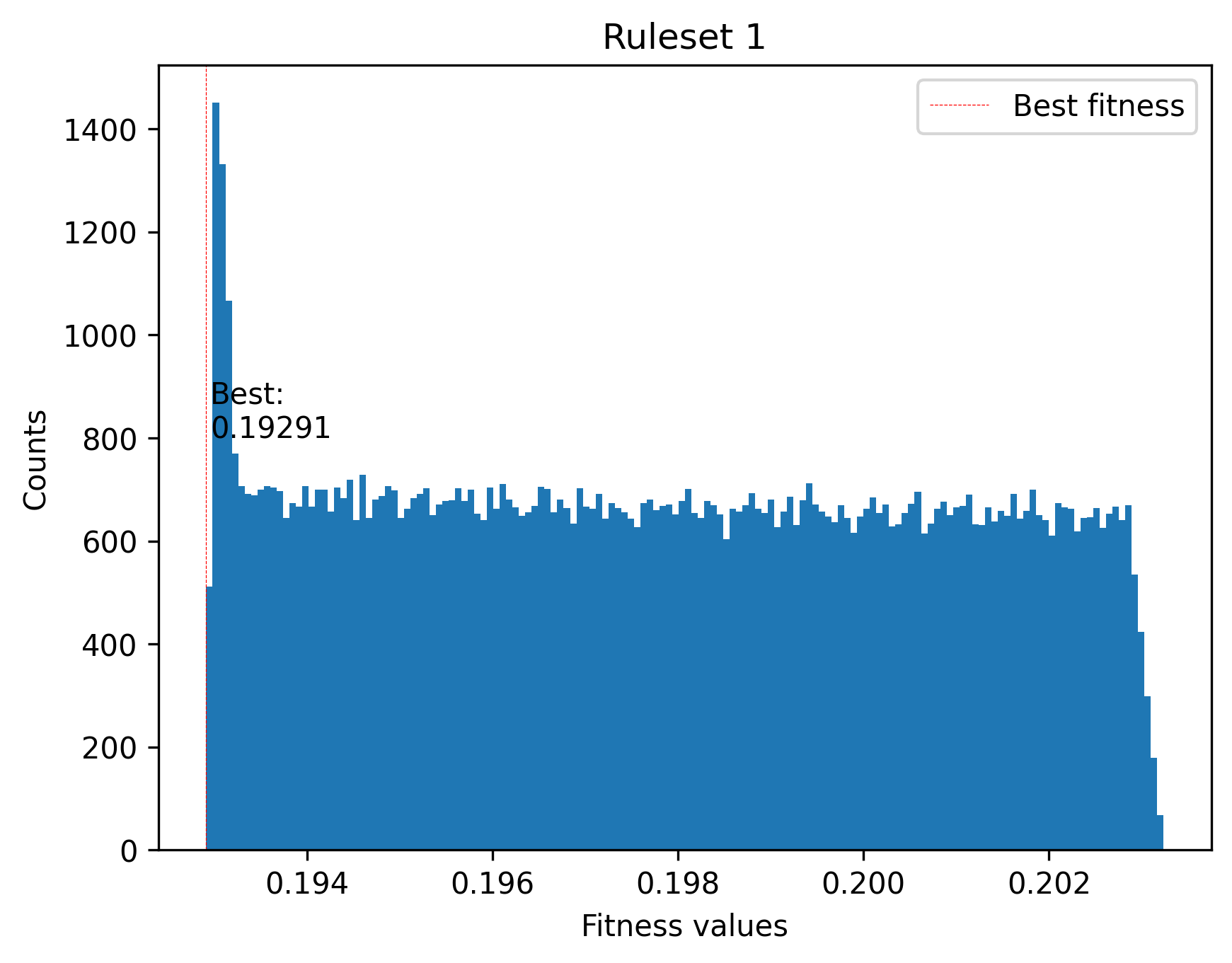
Plot the fitnesses of generated solutions
Utilizing a histogram, we get the general idea on how much the solutions generated based on the rules might vary in their fitness values compared to the best fitness.
[8]:
best_fitness = lemoo._generation_history[-1].fitness_fun_values[0]

fig = plt.figure()
plt.hist(fitness_values_rules, bins=150)
plt.xlabel("Fitness values")
plt.ylabel("Counts")
plt.axvline(best_fitness, c="red", linestyle="dashed", linewidth=0.3, label="Best fitness")
plt.text(best_fitness + 0.00005, 800, f"Best:\n{best_fitness[0].round(5)}")
plt.title("Ruleset 1")
plt.legend()
plt.show()